swastik.boneandjointclinic@gmail.com          +91 9175718457

Understanding Uni-Compartmental Knee Replacement: A Minimally Invasive Option

Knee pain that limits walking, climbing stairs, or enjoying daily routines does not always mean a full knee replacement is the only solution. Over the last decade, advances in orthopaedic surgery have introduced more refined options for patients with localized knee arthritis. One such option is uni-compartmental knee replacement, a minimally invasive procedure designed for carefully selected patients. Understanding how it works, who it benefits, and how it compares with total knee replacement can help patients make confident, informed decisions.


What Is Uni-Compartmental Knee Replacement?

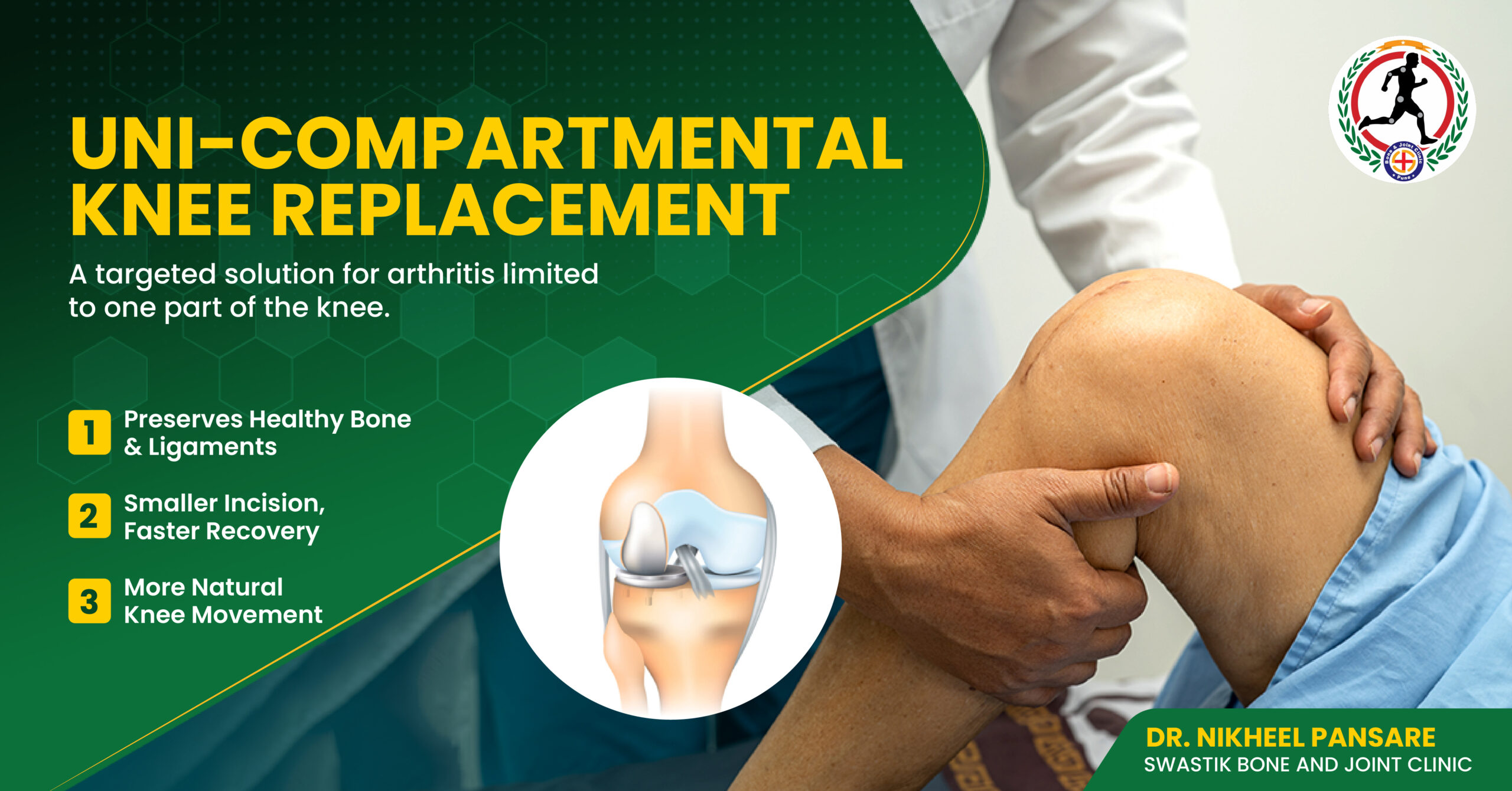
Uni-compartmental knee replacement, often referred to as partial knee replacement, focuses on replacing only the damaged section of the knee rather than the entire joint. The knee has three compartments: medial, lateral, and patellofemoral. In many patients, arthritis affects just one compartment, most commonly the medial side. When pain, stiffness, and cartilage damage are limited to this area, a targeted replacement can be highly effective. Unlike traditional knee replacement, this procedure preserves healthy bone, cartilage, and ligaments. Patients often explore this option in consultation with a knee replacement surgeon in viman nagar when conservative treatments like medication and physiotherapy no longer provide relief.

How It Differs From Total Knee Replacement

The key difference lies in precision and preservation. Total knee replacement involves resurfacing the entire knee joint, while uni-compartmental replacement addresses only the diseased compartment. Because less tissue is disturbed, the surgery is less invasive. This results in a smaller incision, reduced blood loss, and often faster recovery. Patients who consult a Best knee replacement surgeon in Viman Nagar are often surprised to learn that they may not need a complete joint replacement if the disease is localized. This tailored approach has become increasingly popular among active adults who want to maintain a more natural knee movement.

Ideal Candidates for This Procedure

Not every patient with knee pain is suitable for a uni-compartmental knee replacement. Ideal candidates usually have arthritis confined to one compartment, stable knee ligaments, and relatively good range of motion. Conditions like advanced inflammatory arthritis affecting the entire knee may not be suitable. Careful evaluation by a joint replacement surgeon in Viman Nagar is crucial. Imaging studies, physical examination, and lifestyle assessment help determine whether this option will provide lasting benefits or whether another surgical approach would be more appropriate.

Benefits of a Minimally Invasive Approach

One of the biggest advantages of uni-compartmental knee replacement is faster rehabilitation. Since muscle and ligament structures are largely preserved, many patients experience less post-operative pain and regain mobility sooner. Hospital stays are often shorter, and some patients return to normal daily activities in a matter of weeks. There is also a more natural “feel” to the knee after surgery because the healthy parts of the joint remain untouched. This is especially important for patients who lead active lives and want a knee that functions as close to normal as possible. When guided by an experienced Orthopedic Specialist In Viman Nagar, outcomes can be highly satisfying.

Long-Term Outcomes and Durability

Modern implants and improved surgical techniques have significantly enhanced the durability of partial knee replacements. Studies show excellent long-term results when the procedure is performed on the right patient at the right time. If arthritis progresses to other compartments in the future, conversion to a total knee replacement is still possible. This flexibility makes uni-compartmental knee replacement an attractive option for many patients who want pain relief now without compromising future treatment choices.

Recovery and Rehabilitation

Rehabilitation plays a major role in recovery. Patients are encouraged to start gentle movements early to restore strength and flexibility. Physiotherapy focuses on improving range of motion, muscle balance, and gait correction. Many patients find that they regain confidence in their knee quicker compared to traditional surgery, allowing them to resume walking, driving, and light activities sooner.

Why Expertise and Proper Evaluation Matter

The success of uni-compartmental knee replacement depends heavily on accurate diagnosis, precise surgical technique, and careful patient selection. This is not a one-size-fits-all solution. A detailed assessment helps avoid under-treatment or over-treatment, ensuring that surgery truly matches the patient’s condition and lifestyle expectations.

Our Approach at Swastik Bone & Joint Clinic

In the final stages of decision-making, choosing the right place for treatment becomes just as important as choosing the procedure itself. At Swastik Bone & Joint Clinic, we focus on evidence-based care, detailed evaluation, and individualized treatment planning. We take time to explain all available options, including non-surgical treatments, partial knee replacement, and total knee replacement, so patients feel confident and informed.

Comprehensive Knee Care Under One Roof

Our clinic is equipped to manage knee problems from early diagnosis to advanced surgical care and structured rehabilitation. We emphasize patient education, realistic expectations, and long-term joint health. By combining modern surgical techniques with personalized follow-up, we aim to help our patients return to an active, pain-free life with clarity and confidence. Uni-compartmental knee replacement is not just about replacing a worn-out surface; it is about restoring movement while respecting the natural structure of the knee. With the right evaluation and expertise, it can be a powerful, minimally invasive solution for the right candidate.